
Compute Layer
Privacy-preserving distributed computation with WASM execution
Compute Layer
Paraloom's compute layer enables privacy-preserving distributed computation using WASM execution and zkSNARK verification.
Overview
The compute layer provides:
- Real WASM Execution: Sandboxed execution with resource limits
- Multi-Validator Verification: 2/3 consensus on results
- Privacy-Preserving Compute: Hidden input/output with zkSNARK proofs
- Load Balancing: Intelligent job distribution
Architecture
WASM Execution Engine
pub struct WasmEngine {
    runtime: Wasmtime,
    config: ExecutionConfig,
}

pub struct ExecutionConfig {
    memory_limit: usize,    // Default: 64MB
    instruction_limit: u64, // CPU limit
    timeout: Duration,      // Per-job timeout
    concurrent_jobs: usize, // Default: 4
}
Features:
- Runtime: Wasmtime v26.0
- Sandboxed execution environment
- Resource isolation (memory, CPU, time)
- Security: NaN canonicalization, stack limits
Job Types
ZK Proof Generation
Generate zkSNARK proofs for privacy transactions. Typical cost: 0.05-0.1 SOL.
ML Inference
Run machine learning models on encrypted data. Typical cost: 0.1-0.2 SOL.
Aggregation
Aggregate data from multiple sources privately. Typical cost: 0.01-0.05 SOL.
Job Lifecycle
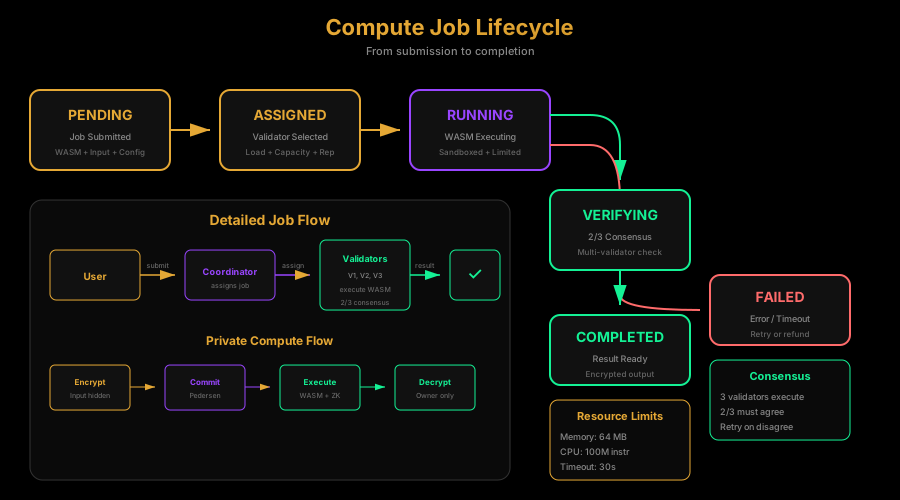
Job Submitted
User submits compute job with:
- WASM bytecode
- Input data (encrypted for private jobs)
- Resource requirements
Job Assigned
Coordinator assigns job to validators based on:
- Validator capacity
- Current load
- Reputation score
Job Executed
Validators execute WASM:
- Sandboxed environment
- Resource limits enforced
- Results collected
Result Verified
For consensus:
- 3 validators execute same job
- 2/3 must agree on result
- Disagreement triggers retry
Job Completed
Result returned to user:
- Encrypted output (private jobs)
- Execution metrics
- Proof of execution
Privacy-Preserving Compute
How It Works
- Private Job Submission: Input data hidden via Pedersen commitments
- Encrypted Execution: Validators process encrypted input/output
- zkSNARK Proofs: Prove correct execution without revealing data
- Multi-Validator Consensus: 2/3 agreement on encrypted results
- Shielded Results: Only job owner can decrypt output
Private Compute Workflow
User creates job with input commitment (data hidden)
    │
    ▼
Job submitted to shielded pool with encrypted input
    │
    ▼
Validators execute WASM with encrypted data
    │
    ▼
Generate zkSNARK proof of correct execution
    │
    ▼
2/3 validators must agree on output commitment
    │
    ▼
Result finalized in shielded pool
    │
    ▼
User retrieves and decrypts output (private)
Code Example
use paraloom::compute::PrivateJob;

// Create private compute job
let job = PrivateJob::new()
    .with_wasm(wasm_code)
    .with_encrypted_input(encrypted_input)
    .with_commitment(input_commitment)
    .build();

// Submit to network
let job_id = network.submit_private_job(job).await?;

// Wait for result
let result = network.get_result(job_id).await?;

// Decrypt output (only owner can decrypt)
let output = result.decrypt(&private_key)?;
Load Balancing
Algorithm
Jobs are distributed based on:
- Capacity: Validators announce available resources
- Current Load: Least-loaded validator preferred
- Reputation: Higher reputation = more jobs
- Latency: Closer validators preferred
fn select_validator(job: &Job, validators: &[Validator]) -> Validator {
    validators
        .iter()
        .filter(|v| v.capacity >= job.requirements)
        .min_by_key(|v| v.current_load)
        .unwrap()
}
Heartbeat System
Validators send heartbeats every 30 seconds:
pub struct Heartbeat {
    validator_id: NodeId,
    capacity: ResourceCapacity,
    current_load: f32,
    timestamp: u64,
}
Stale validators (>60s without heartbeat) are removed from pool.
Resource Limits
Default Limits
| Resource | Limit | Notes |
|---|---|---|
| Memory | 64 MB | Configurable per job |
| Instructions | 1B | CPU limit |
| Execution Timeout | 30s | Per-job default (configurable) |
| Distribution Timeout | 300s | Max time for job assignment |
| Concurrent Jobs | 4 | Per executor |
Enforcing Limits
// Memory limit
engine.set_memory_limit(64 * 1024 * 1024);

// Instruction counting
engine.set_fuel(1_000_000_000);

// Execution timeout (default 30s, configurable)
tokio::time::timeout(Duration::from_secs(30), job.execute()).await?;
Running Compute Jobs
Submit a Job
# Standard compute job
paraloom compute submit \
  --wasm ./my_program.wasm \
  --input ./input.json

# Private compute job (encrypted input/output, zkSNARK proof)
paraloom compute submit \
  --wasm ./my_program.wasm \
  --input ./input.json \
  --private
Check Status
paraloom compute status --job-id <JOB_ID>Get Result
paraloom compute result --job-id <JOB_ID>

# Save output to file
paraloom compute result --job-id <JOB_ID> --output ./result.bin
Compute Demo
Run the built-in demo:
cargo run --bin compute-demoOutput shows:
- 3 validators registering
- 7 jobs submitted
- Load balancing in action
- Results aggregated
Performance
| Metric | Value |
|---|---|
| Simple jobs | Under 1s execution |
| ZK proof generation | Under 5s execution |
| Network overhead | Under 200ms per job |
| Concurrent jobs | 10+ per validator |
Testing
Unit Tests
cargo test --lib computeIntegration Tests
cargo test --test compute_wasm_execution_testPrivate Compute Tests
cargo test private_compute11 tests covering:
- Private job creation
- Input/output commitment
- Multi-validator consensus
- zkSNARK verification
- Result decryption