
Security
Security model and considerations for Paraloom
Security
This document outlines Paraloom's security model, assumptions, and best practices.
Security Model
Cryptographic Assumptions
Paraloom's security relies on:
| Assumption | Description |
|---|---|
| Poseidon Hash | Collision-resistant (128-bit security) |
| Groth16 zkSNARK | Sound under q-SDH assumption |
| BLS12-381 Curve | Discrete log hardness (128-bit) |
| Trusted Setup | Ceremony performed correctly |
Byzantine Fault Tolerance
| Parameter | Value |
|---|---|
| Threshold | 7/10 (70%) |
| Max Malicious | 3/10 validators |
| Reputation System | Reduces unreliable validators |
Threat Model
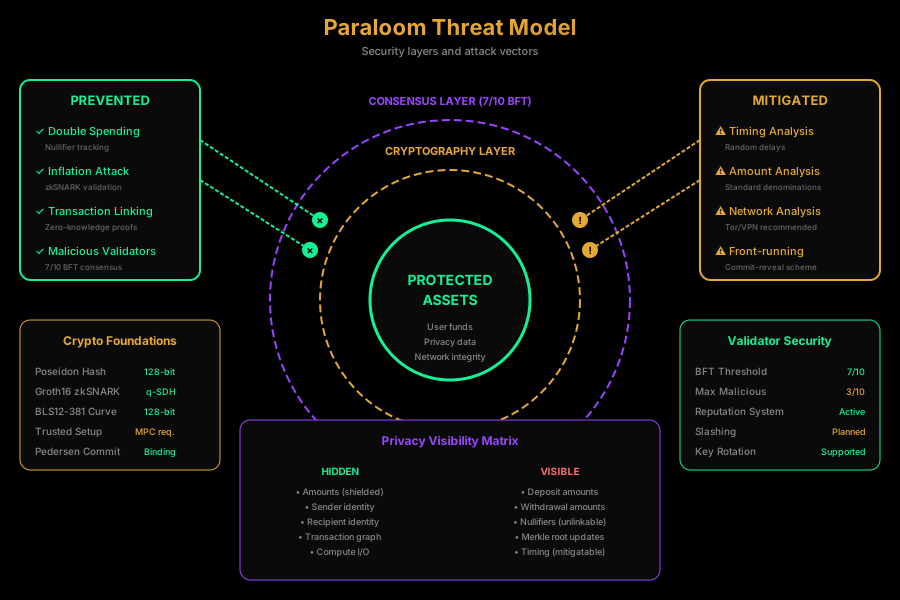
Attacks Prevented
Double Spending
Nullifier tracking prevents spending the same note twice.
Inflation
zkSNARK proofs ensure valid amount transitions.
Transaction Linking
Zero-knowledge proofs hide sender, recipient, and amounts.
Malicious Validators
7/10 consensus threshold tolerates 3 malicious validators.
Attacks NOT Fully Prevented
These attacks require additional mitigation at the application level.
| Attack | Description | Mitigation |
|---|---|---|
| Timing Analysis | Transaction timing may leak information | Use random delays |
| Amount Analysis | Unique amounts can be traced | Use standard denominations |
| Network Analysis | IP addresses may be observed | Use Tor/VPN |
| Front-running | Transactions may be observed in mempool | Use commit-reveal |
Privacy Guarantees
What is Hidden
- Transaction amounts (except at deposit/withdrawal)
- Sender identity
- Recipient identity
- Transaction graph connections
What is Visible
- Deposit events (amount visible)
- Withdrawal events (amount visible)
- Nullifiers (unlinkable to deposits)
- Merkle root updates
Trusted Setup
Current Status: TESTNET ONLY
The current trusted setup is centralized and NOT suitable for production.
Production Requirements
For mainnet deployment:
-
Multi-Party Computation Ceremony
- 50+ independent participants
- Geographically distributed
- Verifiable participation
-
Security Guarantees
- Only 1 honest participant needed
- Public verification of ceremony
- Toxic waste destruction proof
-
Ceremony Process
Participant 1 → Compute → Pass to Participant 2
Participant 2 → Compute → Pass to Participant 3
...
Participant N → Finalize → Publish Keys
Code Security
Audit Status
| Component | Status |
|---|---|
| Privacy Layer | Internal review |
| Consensus | Internal review |
| Bridge | Internal review |
| Solana Program | Internal review |
External security audit planned before mainnet launch.
Known Limitations
-
No Formal Verification
- Circuits not formally verified
- Rust code not formally verified
-
Limited Testing
- 197 tests, but not exhaustive
- Fuzz testing not complete
-
Single Implementation
- No alternative implementations to compare
Validator Security
Secure Key Management
# Generate validator keys securely
paraloom-node keygen \
  --output ./validator-key.json \
  --entropy-source /dev/random

# Set restrictive permissions
chmod 600 ./validator-key.json

# Backup securely (offline)
cp ./validator-key.json /secure/backup/
Network Security
# Firewall configuration
ufw allow 9000/tcp  # P2P
ufw deny 9090/tcp   # Metrics (internal only)

# Rate limiting
iptables -A INPUT -p tcp --dport 9000 \
  -m connlimit --connlimit-above 50 -j REJECT
Monitoring
Monitor for:
- Unusual verification patterns
- Consensus participation drops
- Reputation score changes
- Memory/CPU spikes
User Security
Wallet Security
- Use hardware wallets for large amounts
- Never share private keys or seeds
- Verify addresses before sending
- Test with small amounts first
Note Security
Shielded notes contain:
- Commitment
- Amount
- Randomness
- Secret
If you lose your notes, you lose access to your funds!
Backup strategy:
# Encrypt notes before backup
gpg --symmetric --cipher-algo AES256 notes.json

# Store in multiple locations
cp notes.json.gpg /backup1/
cp notes.json.gpg /backup2/
Privacy Best Practices
-
Use Unique Addresses
- Different deposit address each time
- Different withdrawal address each time
-
Avoid Unique Amounts
- Use standard denominations (1, 10, 100 SOL)
- Split large amounts into smaller transactions
-
Timing Obfuscation
- Wait random intervals between operations
- Don't deposit and withdraw same amount quickly
-
Network Privacy
- Use Tor for transaction submission
- Use VPN as additional layer
Incident Response
Reporting Security Issues
Do NOT publicly disclose security vulnerabilities!
Report to: security@paraloom.network
Include:
- Detailed description
- Steps to reproduce
- Potential impact
- Suggested fix (if any)
Bug Bounty Program
| Severity | Reward |
|---|---|
| Critical | Up to $50,000 |
| High | Up to $20,000 |
| Medium | Up to $5,000 |
| Low | Up to $1,000 |
Roadmap
Before Mainnet
- Multi-party ceremony (50+ participants)
- External security audit
- Formal verification of circuits
- Bug bounty program launch
- Economic security analysis
- Validator network decentralization
Ongoing
- Regular security reviews
- Continuous monitoring
- Incident response procedures
- Community security education