Vision
The future of privacy-preserving DeFi on Solana
Vision: Privacy DeFi Layer for Solana
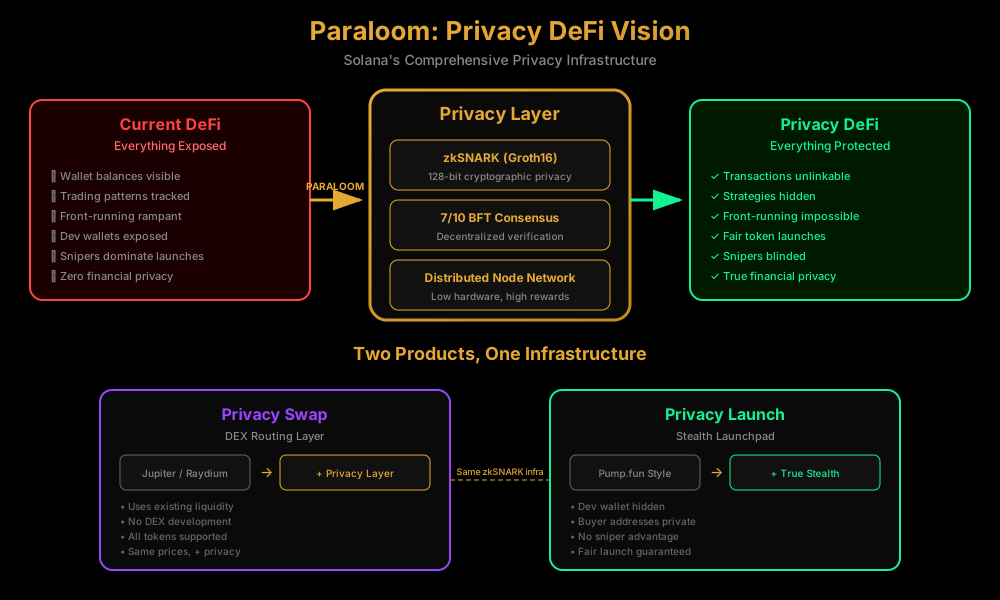
Paraloom is evolving beyond a simple privacy layer into Solana's comprehensive Privacy DeFi infrastructure.
The Problem
Current DeFi is Naked
Every transaction on Solana is completely transparent:
| What's Exposed | Who Exploits It |
|---|---|
| Your wallet balance | Scammers target rich wallets |
| Trading patterns | Competitors copy strategies |
| Large buy orders | Front-runners extract value |
| Token holdings | Social engineers phish you |
| Dev wallets | Snipers dump on launches |
The cost of transparency:
- Whales can't accumulate without moving markets
- Traders can't execute strategies privately
- Projects can't launch fairly
- Users have zero financial privacy
Existing "Solutions" Don't Work
Simple Mixers (5-hop routing):
- All transactions visible on-chain
- Timing correlation attacks
- Amount matching analysis
- Chainalysis breaks them easily
Centralized Services:
- "Trust us bro" model
- Single point of failure
- Can be shut down
- No real privacy guarantee
The Solution: Paraloom
Paraloom provides real privacy through zero-knowledge cryptography, not obfuscation.
Why Paraloom is Different
| Approach | Simple Mixer | Centralized | Paraloom |
|---|---|---|---|
| Privacy Level | Weak | Trust-based | Cryptographic |
| On-chain Visibility | Full | Partial | Zero |
| Decentralization | Fake | None | Real |
| Proof System | None | None | zkSNARK (Groth16) |
| Timing Attacks | Vulnerable | Vulnerable | Resistant |
Technical Foundation (Already Built)
Paraloom's privacy layer uses Zcash Sapling-grade cryptography:
Commitment = Poseidon(value || randomness)
Nullifier = Poseidon(commitment || secret)
Proof = Groth16(witness, public_inputs)- Groth16 zkSNARK: 128-bit security, constant proof size
- Poseidon Hash: zkSNARK-optimized, Zcash parameters
- Merkle Tree: Incremental, 32-level depth
- BFT Consensus: 7/10 validators for withdrawals
Two Products, One Infrastructure
Product 1: Privacy Swap (DEX Routing)
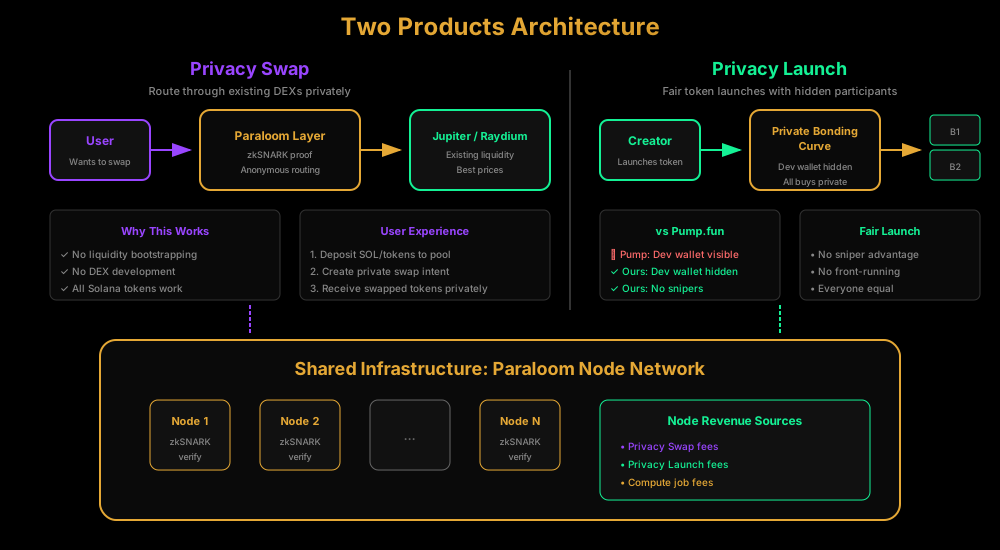
Not a DEX. A privacy layer for existing DEXs.
User → Paraloom Privacy Layer → Jupiter/Raydium → Swap Complete
         ↓
    zkSNARK proof
    Nullifier check
    Anonymous routing
         ↓
    Recipient gets tokens
    No link to sender
How it works:
Deposit to Shielded Pool
User deposits SOL/tokens into Paraloom's shielded pool, receiving a private note.
Generate Swap Intent
User creates an encrypted swap intent (token pair, amount, slippage).
Validators Execute
Paraloom validators verify the zkSNARK proof and execute the swap on Jupiter/Raydium from the pool.
Private Withdrawal
Swapped tokens returned to user's chosen address via private withdrawal.
Why this is powerful:
- No liquidity needed: Uses Raydium/Jupiter's billions in liquidity
- No DEX development: Just privacy routing
- All tokens supported: Anything on Jupiter
- Same prices: No privacy premium on execution
Product 2: Privacy Launch (Stealth Launchpad)
Pump.fun, but actually private.
Current launch platforms expose everything:
- Who bought (wallet addresses)
- How much they bought (amounts)
- Dev wallet holdings (insider info)
- Sniper wallets (unfair advantage)
Paraloom Privacy Launch:
Creator → Private Deploy → Bonding Curve
              ↓
         Dev allocation HIDDEN
         No visible dev wallet
              ↓
Buyers → Shielded Purchase → Tokens
              ↓
         Buyer addresses HIDDEN
         Purchase amounts HIDDEN
         Sniper advantage GONE
Fair launch mechanics:
| Feature | Pump.fun | Paraloom Launch |
|---|---|---|
| Dev wallet visible | Yes | No |
| Buyer addresses | Public | Hidden |
| Sniper advantage | Huge | None |
| Front-running | Easy | Impossible |
| True stealth launch | No | Yes |
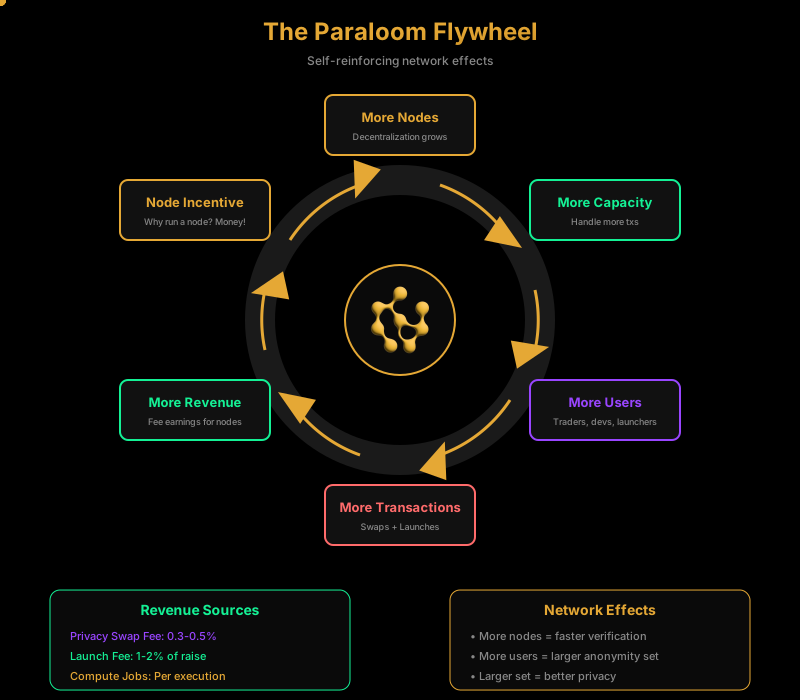
Node Economics: The Flywheel
Why Run a Paraloom Node?
| Revenue Source | Description |
|---|---|
| Privacy Swap Fees | % of every private swap |
| Launch Fees | % of every token launch |
| Verification Rewards | Payment for zkSNARK verification |
| Compute Jobs | Private compute execution fees |
The Flywheel Effect
More Nodes → More Privacy Capacity → More Users
     ↑                                    ↓
More Revenue ← More Transactions ← Better UX
This solves Paraloom's original question: "Why run a node?"
Answer: Real revenue from privacy fees.
Node Requirements
| Tier | Hardware | Expected Revenue |
|---|---|---|
| Light | Raspberry Pi 4 | Entry level |
| Standard | 4 core, 8GB RAM | Medium |
| Power | 8+ core, 16GB RAM | High throughput |
Low barrier to entry = More nodes = More decentralization = Better privacy
Competitive Landscape
Launch Platforms
| Platform | Launch | Privacy | Fair |
|---|---|---|---|
| Pump.fun | Yes | No | No (snipers) |
| Moonshot | Yes | No | No |
| Paraloom | Yes | Yes | Yes |
DEX/Swap
| Platform | Swap | Privacy | Own Liquidity |
|---|---|---|---|
| Jupiter | Yes | No | Aggregated |
| Raydium | Yes | No | Own pools |
| Paraloom | Yes | Yes | Uses theirs |
Privacy Solutions
| Solution | Real Privacy | Decentralized | DeFi Integration |
|---|---|---|---|
| Tornado Cash | Yes | Yes | No (just mixer) |
| Simple Mixers | No | Sometimes | No |
| Paraloom | Yes | Yes | Yes (full DeFi) |
Paraloom sits at the intersection: Real privacy + Full DeFi + Decentralized
Roadmap Integration
Phase 1: Foundation (Complete)
- zkSNARK privacy layer
- Multi-validator consensus
- Solana bridge (deposit/withdraw)
- Private compute layer
Phase 2: Privacy DeFi (Next)
- Jupiter/Raydium integration
- Privacy swap routing
- Bonding curve contracts
- Privacy launch platform
Phase 3: Ecosystem
- SPL token support
- Private NFT transfers
- Cross-chain bridges
- Mobile SDK
Why This Matters
For Users
- Trade without being front-run
- Accumulate without moving markets
- Financial privacy as a right
For Projects
- Fair launches without snipers
- Dev allocations stay private
- Legitimate stealth launches
For Node Operators
- Clear revenue model
- Growing transaction volume
- Network effect benefits
For Solana
- Privacy as infrastructure
- DeFi innovation
- Competitive advantage vs other L1s
Summary
Paraloom is becoming Solana's Privacy DeFi Layer:
| Component | Status | Purpose |
|---|---|---|
| zkSNARK Layer | Built | Real cryptographic privacy |
| Consensus | Built | Decentralized verification |
| Bridge | Built | Solana integration |
| Privacy Swap | Next | Private trading |
| Privacy Launch | Next | Fair token launches |
One infrastructure, two killer products, infinite possibilities.
This vision builds on Paraloom's existing foundation. The zkSNARK infrastructure is already battle-tested. Now we're adding the applications that make privacy useful for everyday DeFi.